Molybdenum
Atomic Data
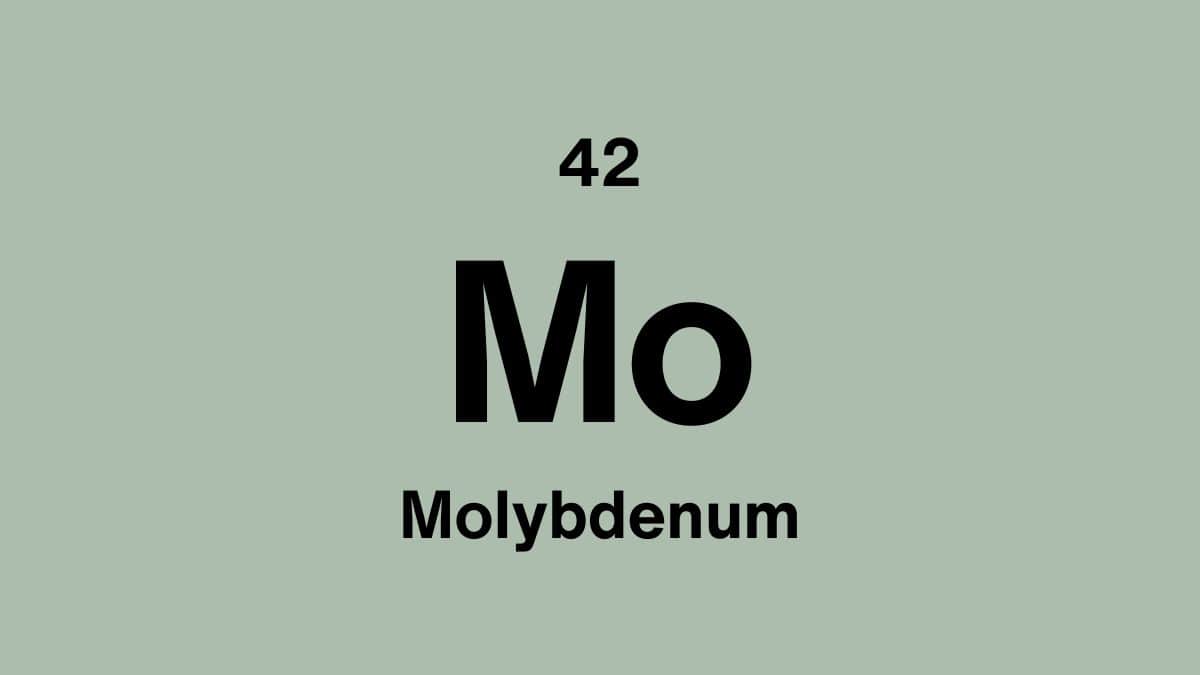
| Atomic Number | 42 |
| Symbol | Mo |
| Atomic Weight | 95.95 u |
| Density (STP) | 10.28 g/cm³ |
| Melting Point | 2622.85 °C (2896 K) |
| Boiling Point | 4638.85 °C (4912 K) |
| Electronegativity | 2.16 (Pauling) |
| Electron Config. | 1s2 2s2 2p6 3s2 3p6 3d10 4s2 4p6 4d5 5s1 |
| Oxidation States | +2, +3, +4, +5, +6 |
| Phase at STP | Solid |
| Category | Transition Metal |
| Period / Group | 5 / 6 |
| CAS Number | 7439-98-7 |
Electron Configuration
[Kr] 4d5 5s1
| Shell | n | Subshell | Electrons | Cumulative |
|---|---|---|---|---|
| K | 1 | 1s | 2 | 2 |
| L | 2 | 2s | 2 | 4 |
| L | 2 | 2p | 6 | 10 |
| M | 3 | 3s | 2 | 12 |
| M | 3 | 3p | 6 | 18 |
| M | 3 | 3d | 10 | 28 |
| N | 4 | 4s | 2 | 30 |
| N | 4 | 4p | 6 | 36 |
| N | 4 | 4d | 5 | 41 |
| O | 5 | 5s | 1 | 42 |
| Total | 42 | 42 | ||
Isotopes of Molybdenum
Molybdenum has seven naturally occurring stable isotopes. The most abundant is ⁹⁸Mo, comprising 24.39% of all naturally occurring Molybdenum.
| Isotope | Symbol | Protons | Neutrons | Abundance | Stability |
|---|---|---|---|---|---|
| Molybdenum-92 | ⁹²Mo | 42 | 50 | 14.53 | Stable |
| Molybdenum-94 | ⁹⁴Mo | 42 | 52 | 9.15 | Stable |
| Molybdenum-95 | ⁹⁵Mo | 42 | 53 | 15.84 | Stable |
| Molybdenum-96 | ⁹⁶Mo | 42 | 54 | 16.67 | Stable |
| Molybdenum-97 | ⁹⁷Mo | 42 | 55 | 9.6 | Stable |
| Molybdenum-98 | ⁹⁸Mo | 42 | 56 | 24.39 | Stable |
| Molybdenum-100 | ¹⁰⁰Mo | 42 | 58 | 9.82 | Stable |
Abundance & Occurrence
Molybdenum is present in Earth's crust at approximately 1.2 ppm by mass and at approximately 5 ppm by mass throughout the universe.
Earth's Crust (ppm by mass)
Universe (ppm by mass)
Discovery & History
Read more about the discovery of the periodic table of elements →
Safety & Handling
- Molybdenum trioxide fumes: Heating or processing molybdenum generates MoO3 fumes; inhalation causes acute irritation of the respiratory tract and, with repeated exposure, may cause systemic effects on the liver and kidneys.
- Gout-like effects: Elevated molybdenum intake in copper-deficient individuals causes a gout-like syndrome (molybdenosis) in livestock; comparable human effects are rare but possible with extreme industrial exposures.
- Molybdenum hexafluoride (MoF6): Used in isotope separation; it is a highly reactive, corrosive gas that reacts violently with water and requires specialised handling.
- Dust exposure: Fine molybdenum powder is combustible; standard dust precautions and ventilation apply when machining or grinding molybdenum-containing materials.
Molybdenum in the Real World
Real-World Uses
- Steel and alloy strengthening: Molybdenum additions (0.2–8%) increase hardenability, creep resistance, and corrosion resistance in tool steels, stainless steels, and cast irons used in drill bits, dies, high-pressure vessels, and aerospace structures.
- Dry lubricant: Molybdenum disulfide (MoS₂) is a solid lubricant with a layered crystal structure that shears easily; applied as a powder or grease additive, it reduces friction in bearings, gears, and fasteners at extreme loads and temperatures.
- Catalysts in petroleum refining: Molybdenum-based catalysts (with cobalt or nickel promoters) are used in hydrodesulfurisation (HDS) to remove sulfur from petroleum fractions, producing low-sulfur diesel and petrol that meet environmental regulations.
- High-temperature electrodes: Molybdenum electrodes withstand the extreme temperatures (>1400 °C) inside glass-melting furnaces, maintaining conductivity and dimensional stability where most metals would melt or oxidise.
- Biological cofactor: Molybdenum is an essential trace element for most organisms; it is the metal centre in nitrogenase enzymes (biological nitrogen fixation) and xanthine oxidase (purine metabolism) in animals including humans.
Downloadable Resources
Free periodic table reference sheets for classrooms, study sessions, and laboratory use.
Frequently Asked Questions
What is molybdenum used for?
Molybdenum is used primarily as an alloying element in steel and cast iron, where it improves hardness, toughness, and high-temperature strength. Molybdenum high-speed steels retain their hardness even when red-hot, making them ideal for cutting tools. Molybdenum disulphide (MoS2) is an excellent dry lubricant used in high-temperature, high-vacuum, or radiation environments where oil would fail.
Is molybdenum essential for life?
Yes, molybdenum is an essential trace element for nearly all living organisms. It is a cofactor for several important enzymes, including nitrogenase (which fixes atmospheric nitrogen in bacteria), sulphite oxidase (in humans and animals), and xanthine oxidase. Humans require only about 45–75 micrograms per day, easily obtained from legumes, grains, and organ meats.
How was molybdenum discovered?
Molybdenum was identified as a distinct element in 1778 by Swedish chemist Carl Wilhelm Scheele, who showed that molybdenite (MoS2) was not a lead ore as previously thought. The metal was first isolated in 1781 by Peter Jacob Hjelm. Its name comes from the Greek 'molybdos', meaning lead, since molybdenite was often confused with lead sulphide or graphite.
What makes molybdenum disulphide a good lubricant?
Molybdenum disulphide has a layered crystal structure similar to graphite. Each layer consists of a sheet of molybdenum atoms sandwiched between two sheets of sulphur atoms. The layers are held together by weak van der Waals forces and slide easily past one another. Unlike oil-based lubricants, MoS2 works better under high pressure (the layers bond more strongly to metal surfaces under load) and functions in high-temperature and vacuum conditions.