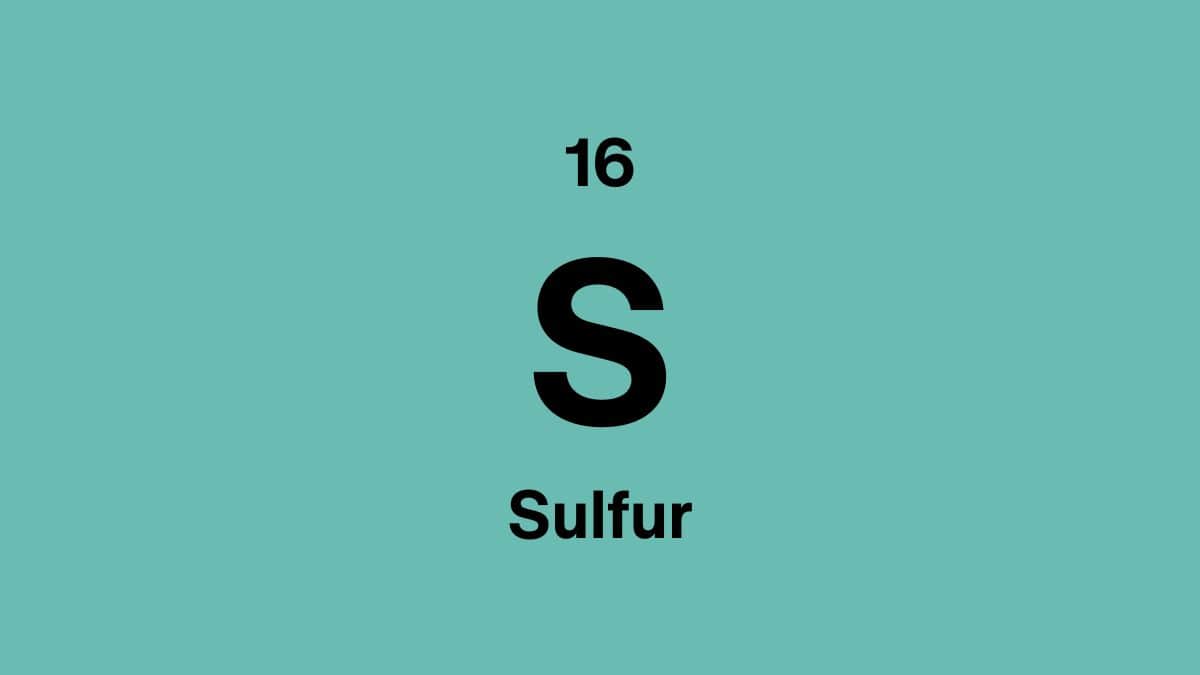
Sulfur
Atomic Data
| Atomic Number | 16 |
| Symbol | S |
| Atomic Weight | 32.06 u |
| Density (STP) | 2.067 g/cm³ |
| Melting Point | 115.21 °C (388.36 K) |
| Boiling Point | 444.6 °C (717.75 K) |
| Electronegativity | 2.58 (Pauling) |
| Electron Config. | 1s2 2s2 2p6 3s2 3p4 |
| Oxidation States | −2, +2, +4, +6 |
| Phase at STP | Solid |
| Category | Reactive Nonmetal |
| Period / Group | 3 / 16 |
| CAS Number | 7704-34-9 |
Electron Configuration
[Ne] 3s2 3p4
| Shell | n | Subshell | Electrons | Cumulative |
|---|---|---|---|---|
| K | 1 | 1s | 2 | 2 |
| L | 2 | 2s | 2 | 4 |
| L | 2 | 2p | 6 | 10 |
| M | 3 | 3s | 2 | 12 |
| M | 3 | 3p | 4 | 16 |
| Total | 16 | 16 | ||
Isotopes of Sulfur
Sulfur has four naturally occurring stable isotopes. The most abundant is ³²S, comprising 94.99% of all naturally occurring Sulfur.
| Isotope | Symbol | Protons | Neutrons | Abundance | Stability |
|---|---|---|---|---|---|
| Sulfur-32 | ³²S | 16 | 16 | 94.99 | Stable |
| Sulfur-33 | ³³S | 16 | 17 | 0.75 | Stable |
| Sulfur-34 | ³⁴S | 16 | 18 | 4.25 | Stable |
| Sulfur-36 | ³⁶S | 16 | 20 | 0.01 | Stable |
Abundance & Occurrence
Sulfur is present in Earth's crust at approximately 350 ppm by mass and at approximately 440 ppm by mass throughout the universe.
Earth's Crust (ppm by mass)
Universe (ppm by mass)
Discovery & History
Read more about the discovery of the periodic table of elements →
Safety & Handling
- Sulfur dioxide toxicity: Burning sulfur or sulfur-containing materials produces sulfur dioxide (SO2), an acrid, toxic gas that irritates the respiratory tract; high concentrations cause pulmonary oedema and can be fatal.
- Hydrogen sulfide hazard: H2S, produced when sulfur compounds react with acids or in anaerobic decomposition, is highly toxic: comparable to hydrogen cyanide: and dangerously desensitises the sense of smell at moderate concentrations.
- Dust and fire: Sulfur dust forms explosive mixtures with air; bulk sulfur can ignite if subjected to friction or spark, especially in the presence of oxidising agents.
- Skin and eye irritation: Direct contact with sulfur dust causes mild irritation; sulfuric acid, the industrial derivative, is severely corrosive and one of the most hazardous bulk chemicals in industrial use.
Sulfur in the Real World
Real-World Uses
- Sulfuric acid production: More sulfuric acid is produced annually than any other industrial chemical; it is used in fertiliser manufacture, petroleum refining, metal ore processing, battery electrolyte, and chemical synthesis.
- Rubber vulcanisation: Elemental sulfur cross-links natural and synthetic rubber polymer chains during vulcanisation, converting soft, tacky latex into the durable, elastic rubber used in tyres, seals, and hoses.
- Fungicides and pesticides: Elemental sulfur and sulfur-containing compounds are among the oldest and most widely used agricultural fungicides, effective against powdery mildew, black spot, and mite infestations in vineyards and orchards.
- Pharmaceuticals and personal care: Sulfur compounds appear in antibiotics (sulfonamides), diuretics, anti-inflammatory drugs, and in acne treatments and medicated shampoos that exploit sulfur's keratolytic and antimicrobial properties.
- Paper and pulp (kraft process): The sulfate/kraft pulping process uses sodium sulfide and sodium hydroxide to dissolve lignin from wood chips, producing the strong chemical pulp used in most paper and cardboard production.
- Gunpowder: Traditional black powder consists of potassium nitrate, charcoal, and sulfur; sulfur lowers the ignition temperature and helps sustain combustion, making it a historical propellant and pyrotechnic ingredient.
Downloadable Resources
Free periodic table reference sheets for classrooms, study sessions, and laboratory use.
Frequently Asked Questions
What is sulfur used for?
Sulfur's most important use is in the production of sulfuric acid, the world's most produced industrial chemical, used in fertilisers, petroleum refining, battery electrolyte, and chemical synthesis. Sulfur is also used to vulcanise rubber, as an agricultural fungicide and pesticide, in pharmaceuticals, in the kraft paper-pulping process, and historically in gunpowder.
What does sulfur smell like?
Pure elemental sulfur is actually odourless. The distinctive rotten-egg smell commonly associated with sulfur is caused by hydrogen sulfide (H₂S), a toxic gas produced by the bacterial breakdown of sulfur-containing proteins and by volcanic activity. Other pungent sulfur compounds include sulfur dioxide (SO₂, the acrid smell of burning sulfur matches) and thiols (the mercaptans added to odourless natural gas as a safety odorant).
Is sulfur essential for life?
Yes, sulfur is an essential element for all living organisms. It is present in the amino acids cysteine and methionine, which are components of proteins. Disulfide bonds (S–S) between cysteine residues help maintain the three-dimensional structure of proteins and enzymes. Sulfur is also part of important coenzymes, including coenzyme A, biotin, and thiamine (vitamin B₁), and is a key component of the iron-sulfur clusters in many electron-transfer enzymes.
Where does sulfur come from?
Most commercial sulfur is recovered as a by-product of oil and gas processing: the hydrodesulfurisation process removes sulfur from petroleum and natural gas to produce clean fuels, and the elemental sulfur is captured rather than emitted as SO₂. Additional sulfur comes from smelting of sulfide ores (pyrite, chalcopyrite, sphalerite). Natural deposits of elemental sulfur occur around volcanic vents and salt dome cap rocks, where it was deposited by bacterial reduction of calcium sulfate.