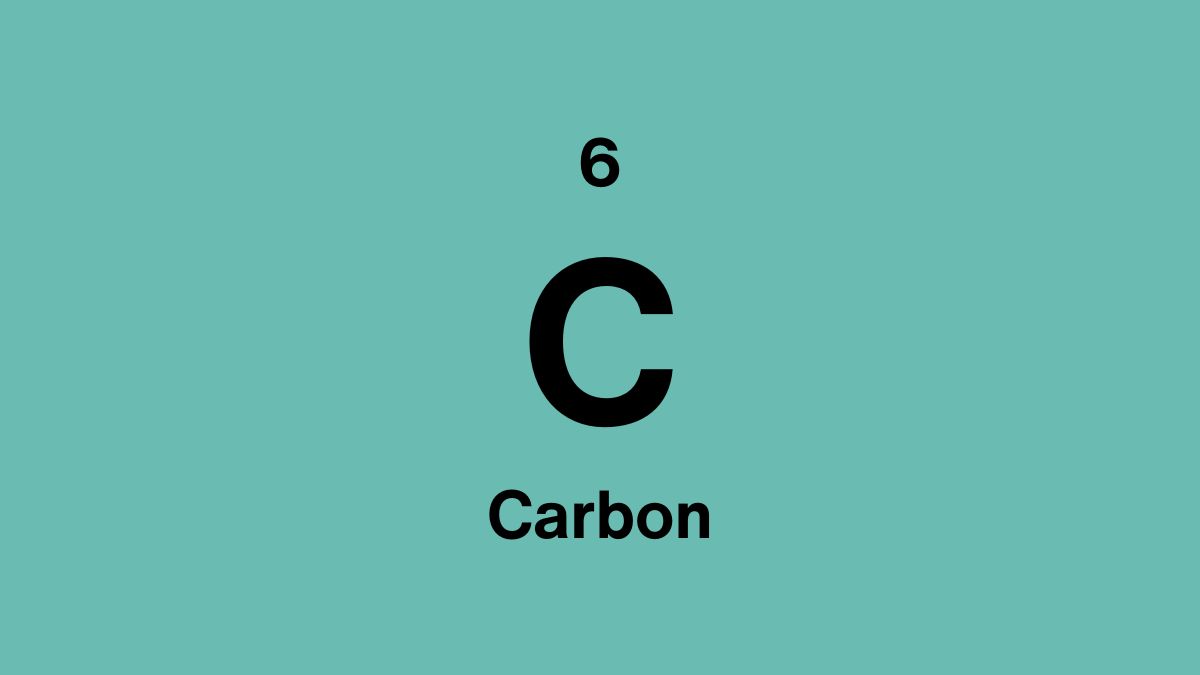
Carbon
Atomic Data
| Atomic Number | 6 |
| Symbol | C |
| Atomic Weight | 12.011 u |
| Density (STP) | 2.267 g/cm³ |
| Melting Point | 3549.85 °C (3823 K) |
| Boiling Point | 3824.85 °C (4098 K) |
| Electronegativity | 2.55 (Pauling) |
| Electron Config. | 1s2 2s2 2p2 |
| Oxidation States | −4, +2, +4 |
| Phase at STP | Solid |
| Category | Reactive Nonmetal |
| Period / Group | 2 / 14 |
| CAS Number | 7440-44-0 |
Electron Configuration
[He] 2s2 2p2
| Shell | n | Subshell | Electrons | Cumulative |
|---|---|---|---|---|
| K | 1 | 1s | 2 | 2 |
| L | 2 | 2s | 2 | 4 |
| L | 2 | 2p | 2 | 6 |
| Total | 6 | 6 | ||
Abundance & Occurrence
Carbon is present in Earth's crust at approximately 200 ppm by mass and at approximately 5000 ppm by mass throughout the universe.
Earth's Crust (ppm by mass)
Universe (ppm by mass)
Discovery & History
Read more about the discovery of the periodic table of elements →
Safety & Handling
- Carbon black and fine dust: Finely divided carbon (soot, activated carbon, carbon black) is a respiratory irritant; chronic occupational inhalation is associated with lung function reduction and is classified as a possible carcinogen (IARC Group 2B).
- Carbon monoxide hazard: Incomplete combustion of carbon or carbon-containing fuels produces carbon monoxide (CO), a colourless, odourless gas that is acutely toxic; CO binds haemoglobin with far greater affinity than oxygen, causing rapid asphyxiation.
- Carbon dioxide accumulation: CO2 from dry ice sublimation or fermentation can accumulate in basements or confined spaces to asphyxiating concentrations; install CO2 monitors and ensure ventilation.
- Dry ice (solid CO2): Dry ice sublimes at −78.5 °C; contact causes cryogenic burns. Never store dry ice in a sealed container: pressure build-up can cause explosive rupture.
Carbon in the Real World
Real-World Uses
- Steel and metallurgy: Coke (a carbon-rich solid derived from coal) is the reducing agent in blast furnaces that converts iron ore to pig iron; carbon content is also precisely controlled to tune the hardness and strength of steel.
- Carbon fibre composites: Carbon fibres embedded in polymer matrices produce materials that are stronger and lighter than steel, used in aircraft fuselages, sports equipment, wind turbine blades, and racing cars.
- Graphite electrodes and lubricants: Graphite's layered structure makes it an excellent dry lubricant and electrical conductor, used in lithium-ion battery anodes, electrodes for electric arc furnaces, and as a solid lubricant in locks and hinges.
- Diamond tooling and abrasives: Diamond, the hardest natural material, is used in drill bits, cutting discs, polishing compounds, and wire drawing dies; synthetic diamonds produced by HPHT and CVD methods now dominate industrial use.
- Activated carbon filtration: Highly porous activated carbon adsorbs organic contaminants and chlorine from drinking water, removes volatile organic compounds from air, and is used as a treatment for poisoning in emergency medicine.
- Carbon black in tyres: Carbon black (fine carbon particles) is dispersed in rubber to reinforce tyre sidewalls and treads, dramatically increasing abrasion resistance and extending tyre life.
- Carbon dioxide (CO₂) applications: CO₂ is used as a refrigerant, as carbonation in beverages, to maintain controlled atmospheres in food storage, and in fire extinguishers, all derived from carbon's combustion and industrial processes.
Downloadable Resources
Free periodic table reference sheets for classrooms, study sessions, and laboratory use.
Frequently Asked Questions
What makes carbon unique among elements?
Carbon is unique in its ability to form an almost limitless number of compounds by bonding with itself and other elements in chains, rings, and three-dimensional networks. This property (catenation), combined with carbon’s ability to form single, double, and triple bonds and its medium electronegativity, makes it the basis of all known life and of the enormous field of organic chemistry, which includes millions of distinct compounds.
What are the main forms (allotropes) of carbon?
Carbon has several allotropes with dramatically different properties. Diamond is the hardest natural material, transparent, and an electrical insulator. Graphite is soft, black, conducts electricity, and is used in pencils and battery anodes. Fullerenes (such as buckminsterfullerene, C₆₀) are hollow spherical molecules. Carbon nanotubes are cylindrical graphene sheets with extraordinary tensile strength. Graphene is a single-atom-thick layer of carbon with remarkable electrical and mechanical properties.
What is carbon dating and how does it work?
Radiocarbon dating (carbon-14 dating) uses the radioactive decay of carbon-14 (t½ = 5,730 years) to determine the age of once-living organic materials up to about 50,000 years old. While alive, organisms continuously incorporate atmospheric C-14 (produced by cosmic ray bombardment of nitrogen-14) into their tissues. After death, the C-14 decays without replenishment; measuring the ratio of C-14 to stable C-12 reveals how long ago the organism died.
Is carbon dioxide the same as carbon?
No. Carbon is a solid element (symbol C, atomic number 6), while carbon dioxide (CO₂) is a gaseous compound of one carbon atom bonded to two oxygen atoms. Carbon forms CO₂ when it burns in excess oxygen or when organic matter decomposes. While CO₂ is essential for plant photosynthesis, its increasing concentration in the atmosphere due to fossil fuel combustion is the primary driver of current climate change.