Sodium
Atomic Data
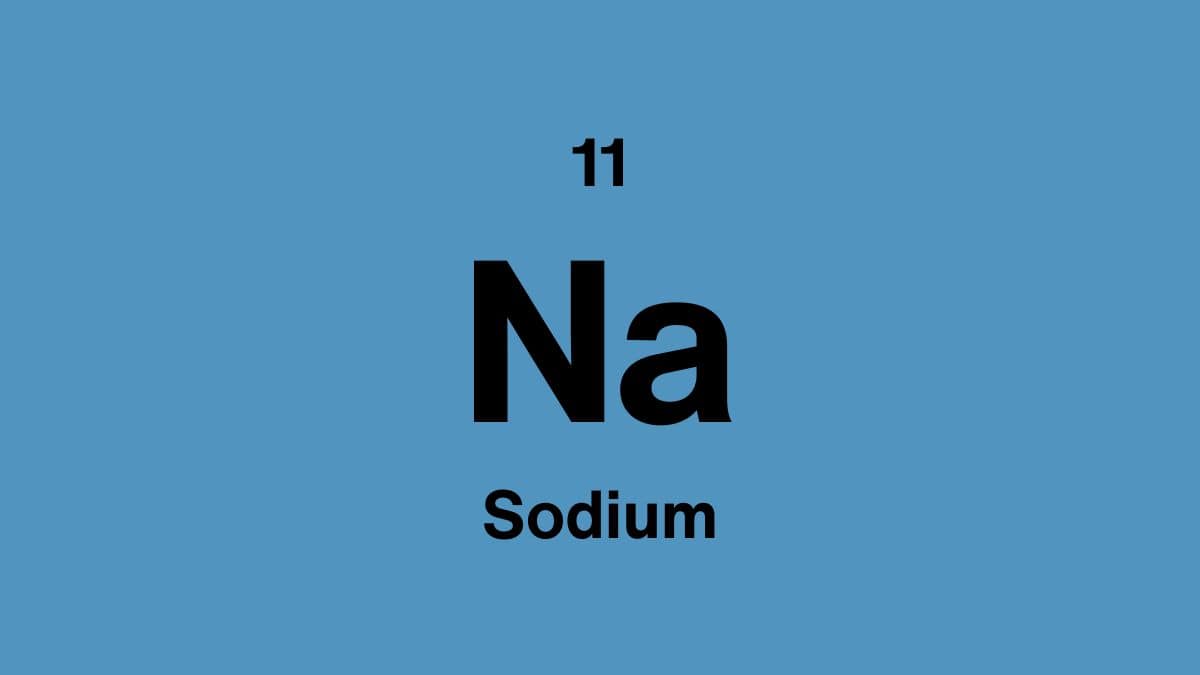
| Atomic Number | 11 |
| Symbol | Na |
| Atomic Weight | 22.99 u |
| Density (STP) | 0.971 g/cm³ |
| Melting Point | 97.72 °C (370.87 K) |
| Boiling Point | 882.85 °C (1156 K) |
| Electronegativity | 0.93 (Pauling) |
| Electron Config. | 1s2 2s2 2p6 3s1 |
| Oxidation States | +1 |
| Phase at STP | Solid |
| Category | Alkali Metal |
| Period / Group | 3 / 1 |
| CAS Number | 7440-23-5 |
Electron Configuration
[Ne] 3s1
| Shell | n | Subshell | Electrons | Cumulative |
|---|---|---|---|---|
| K | 1 | 1s | 2 | 2 |
| L | 2 | 2s | 2 | 4 |
| L | 2 | 2p | 6 | 10 |
| M | 3 | 3s | 1 | 11 |
| Total | 11 | 11 | ||
Isotopes of Sodium
Sodium is monoisotopic: ²³Na is its only naturally occurring stable isotope, accounting for 100% of all natural Sodium.
| Isotope | Symbol | Protons | Neutrons | Abundance | Stability |
|---|---|---|---|---|---|
| Sodium-23 | ²³Na | 11 | 12 | 100 | Stable |
Abundance & Occurrence
Sodium is present in Earth's crust at approximately 23600 ppm by mass and at approximately 20 ppm by mass throughout the universe.
Earth's Crust (ppm by mass)
Universe (ppm by mass)
Discovery & History
Read more about the discovery of the periodic table of elements →
Safety & Handling
- Violent water reactivity: Sodium metal reacts violently with water and moist air, generating hydrogen gas and sodium hydroxide; even small pieces can ignite the evolved hydrogen, producing a bright yellow flame and spattering caustic liquid.
- Skin and eye contact: Contact with sodium metal or sodium hydroxide solution causes severe alkaline burns; sodium hydroxide is particularly destructive to eye tissue: flush immediately with copious water and seek medical attention.
- Fire hazard: Sodium fires must not be extinguished with water or CO2; use dry sand, sodium chloride powder, or Class D extinguishers. Water will intensify the fire and cause explosive spattering.
- Storage: Store sodium under mineral oil or kerosene in a cool, dry, sealed container away from water, oxidising agents, and halogenated solvents; never allow sodium to be exposed to moist air for extended periods.
Sodium in the Real World
Real-World Uses
- Table salt and food preservation: Sodium chloride (NaCl) is the most widely consumed sodium compound; it is used to season food, preserve meat and fish by osmotic dehydration, and as a de-icing agent on roads.
- Street lighting: Low-pressure sodium vapour lamps emit an intense monochromatic yellow light (589 nm) with extremely high efficiency, widely used in street and motorway lighting despite their poor colour rendering.
- Chemical manufacturing: Sodium hydroxide (lye/caustic soda) is one of the most produced industrial chemicals, used in paper and pulp processing, soap and detergent manufacture, alumina refining, and textile treatment.
- Baking: Sodium bicarbonate (baking soda) is a leavening agent that releases CO₂ when heated or acidified, causing doughs and batters to rise in baking.
- Nuclear reactor coolant: Liquid sodium is used as the coolant in fast breeder reactors due to its excellent thermal conductivity, low neutron moderation, and high boiling point, though it reacts violently with water.
- Pharmaceuticals: Sodium salts of active pharmaceutical ingredients (aspirin as sodium acetylsalicylate, penicillin as sodium penicillin G) improve solubility and bioavailability for intravenous and oral dosage forms.
Downloadable Resources
Free periodic table reference sheets for classrooms, study sessions, and laboratory use.
Frequently Asked Questions
What is sodium used for?
Sodium's most familiar use is as table salt (sodium chloride, NaCl), essential for seasoning and food preservation. Sodium hydroxide (caustic soda) is one of the most produced industrial chemicals, used in making soap, paper, and aluminium. Sodium vapour lamps provide efficient street lighting. Sodium bicarbonate is used in baking and medicine. Liquid sodium is used as a reactor coolant in fast-breeder nuclear reactors.
Why does sodium react with water?
Sodium reacts with water because it is a strongly reducing alkali metal with a single loosely-held valence electron. When sodium contacts water, the sodium atom donates its electron to water, reducing water to hydroxide ions and hydrogen gas, while sodium becomes Na⁺ ions. The reaction releases a large amount of heat, which can ignite the hydrogen gas produced, causing the burning and sometimes violent reaction you see in laboratory demonstrations.
Is sodium the same as salt?
No, sodium (Na) is a pure silvery-white metal that reacts dangerously with water, while salt (sodium chloride, NaCl) is a white crystalline compound of sodium and chlorine. In salt, sodium exists as a positively charged Na⁺ ion, which is chemically stable, soluble in water, and safe to consume. The sodium in your diet comes from salt and other sodium compounds (baking soda, monosodium glutamate), not from the metal.
How much sodium do we need in our diet?
Sodium is an essential electrolyte for maintaining fluid balance, nerve signal transmission, and muscle contraction. The World Health Organization recommends less than 2 g of sodium per day (equivalent to about 5 g of salt) for adults. Most people in developed countries consume significantly more than this, which is associated with elevated blood pressure and increased risk of cardiovascular disease and stroke.