Silicon
Atomic Data
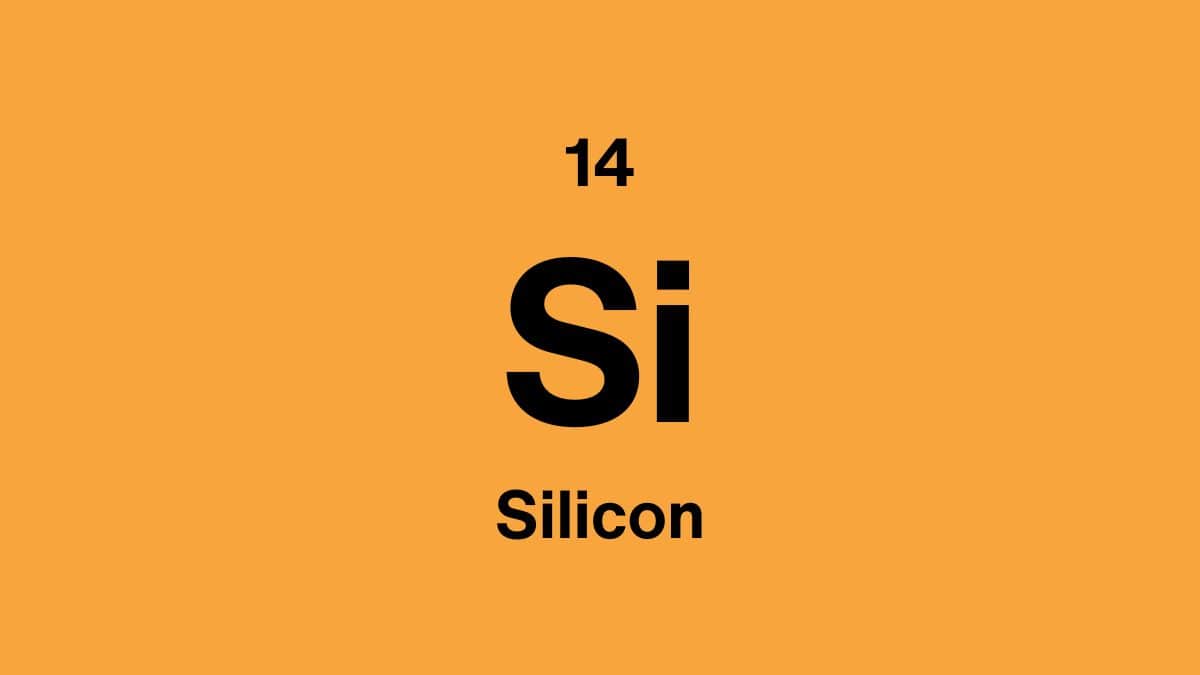
| Atomic Number | 14 |
| Symbol | Si |
| Atomic Weight | 28.085 u |
| Density (STP) | 2.329 g/cm³ |
| Melting Point | 1413.85 °C (1687 K) |
| Boiling Point | 3264.85 °C (3538 K) |
| Electronegativity | 1.90 (Pauling) |
| Electron Config. | 1s² 2s² 2p&sup6; 3s² 3p² |
| Oxidation States | +4, +2, −4 |
| Phase at STP | Solid |
| Category | Metalloid |
| Period / Group | 3 / 14 |
| CAS Number | 7440-21-3 |
Electron Configuration
1s2 2s2 2p6 3s2 3p2
| Shell | n | Subshell | Electrons | Cumulative |
|---|---|---|---|---|
| K | 1 | 1s | 2 | 2 |
| L | 2 | 2s | 2 | 4 |
| L | 2 | 2p | 6 | 10 |
| M | 3 | 3s | 2 | 12 |
| M | 3 | 3p | 2 | 14 |
| Total | 14 | 14 | ||
Isotopes of Silicon
Silicon has three stable naturally occurring isotopes. Silicon-28 is overwhelmingly dominant at 92.23% natural abundance, making silicon one of the more isotopically uniform elements. No naturally occurring radioactive isotopes exist, though silicon-32 is a trace cosmogenic radioisotope produced by cosmic rays in the atmosphere.
| Isotope | Symbol | Protons | Neutrons | Abundance | Stability |
|---|---|---|---|---|---|
| Silicon-28 | ²⁸Si | 14 | 14 | 92.23% | Stable |
| Silicon-29 | ²⁹Si | 14 | 15 | 4.67% | Stable |
| Silicon-30 | ³₀Si | 14 | 16 | 3.10% | Stable |
Abundance & Occurrence
Silicon is the second most abundant element in Earth's crust at approximately 28% by mass, surpassed only by oxygen. It is never found in pure elemental form in nature — it occurs exclusively in compounds, most commonly as silicon dioxide (SiO₂) in quartz and sand, and as silicate minerals in rocks such as feldspar, mica, and granite. This near-universal presence makes silicon one of the most industrially important elements on the planet.
EARTH'S CRUST COMPOSITION (BY MASS)
GLOBAL SILICON PRODUCTION (BY USE)
Discovery & History
Safety & Handling
- Silicosis hazard: Prolonged inhalation of fine crystalline silica dust — generated during quartz cutting, sandblasting, and mining — causes silicosis, an incurable and potentially fatal lung disease. Respiratory protection is mandatory in such environments.
- Bulk elemental silicon is generally considered non-toxic and is not known to cause harm through skin contact or ingestion under normal conditions.
- Silicon tetrachloride (SiCl₄): A common processing intermediate that is highly corrosive. It reacts violently with water to release hydrochloric acid fumes and must be handled with chemical-resistant PPE inside a fume hood.
- Silane gas (SiH₄): Used widely in semiconductor manufacturing; it is pyrophoric, meaning it ignites spontaneously in air, and requires strict gas-handling protocols with appropriate continuous leak detection systems.
- Silicone polymers and silicon dioxide (glass, sand) are biologically inert and are used safely in food-contact materials, cookware, and medical implants with no known toxicity concerns.
- Storage: Pure silicon wafers and powders should be stored away from strong oxidisers and fluorine-containing compounds, which react vigorously with silicon even at moderate temperatures.
Silicon in the Real World
Real-World Uses
- Semiconductor chips — Ultra-pure silicon wafers are the substrate for virtually all integrated circuits, microprocessors, and memory chips. Its controllable conductivity, stable oxide layer (SiO₂), and abundance make it the dominant semiconductor material by a wide margin.
- Solar photovoltaic cells — Crystalline silicon, both monocrystalline and polycrystalline, accounts for over 90% of solar panels worldwide, converting sunlight directly into electricity through the photovoltaic effect.
- Glass and ceramics — Silicon dioxide (SiO₂) is the primary component of window glass, laboratory glassware, and optical instruments. High-purity fused silica is used for UV-transmitting optics and specialty applications.
- Optical fibres — High-purity fused silica fibres carry data as pulses of light across intercontinental telecommunications networks with extremely low signal attenuation, forming the backbone of the internet.
- Silicone polymers — Synthetic polysiloxane materials derived from silicon are used in sealants, lubricants, medical implants, cookware coatings, and personal care products because of their thermal stability and chemical inertness.
- Concrete and construction — Sand (largely SiO₂) is a primary aggregate in concrete and mortar. Silicon carbide (SiC) serves as an industrial abrasive and high-temperature refractory material.
- Steel production — Ferrosilicon is added to molten steel as a deoxidiser and alloying agent. Silicon steel, with controlled silicon content, is the standard core material for electrical power transformers due to its low magnetic losses.
Downloadable Resources
Free periodic table reference sheets for classrooms, study sessions, and laboratory use.
Frequently Asked Questions
What is silicon used for?
Silicon is used primarily in semiconductor chips that power computers, smartphones, and electronic devices. It is also essential for solar photovoltaic cells, glass and ceramics, silicone polymers, optical fibres, and as a deoxidiser in steel production.
Is silicon the same as silicone?
No. Silicon is a naturally occurring metalloid element (Si), while silicone is a synthetic polymer made from silicon, oxygen, carbon, and hydrogen. Silicones are used in sealants, medical implants, lubricants, and cookware. The two are chemically very different despite having similar names.
Why is silicon used in computer chips?
Silicon is used in computer chips because it is a semiconductor — its electrical conductivity can be precisely controlled by adding small amounts of impurities (doping). It is also abundant, relatively cheap to refine to extreme purity, forms a stable oxide layer (SiO₂) useful for insulation, and can be processed into very thin, large-diameter wafers.
Where is silicon found in nature?
Silicon is the second most abundant element in Earth’s crust at about 28% by mass, but it almost never occurs as a pure element. It is found in quartz (SiO₂), sand, feldspar, mica, and thousands of silicate minerals. The ocean floor and most continental rocks are largely silicate compounds.
Who discovered silicon?
Silicon was first isolated in pure form by Swedish chemist Jöns Jacob Berzelius in 1824. He reduced potassium fluorosilicate with potassium metal to obtain amorphous silicon powder. Earlier, Antoine Lavoisier had identified silica as a compound in 1789, and Humphry Davy attempted but failed to isolate the element in 1808.