Promethium
LANTHANOID · GROUP None · PERIOD 6
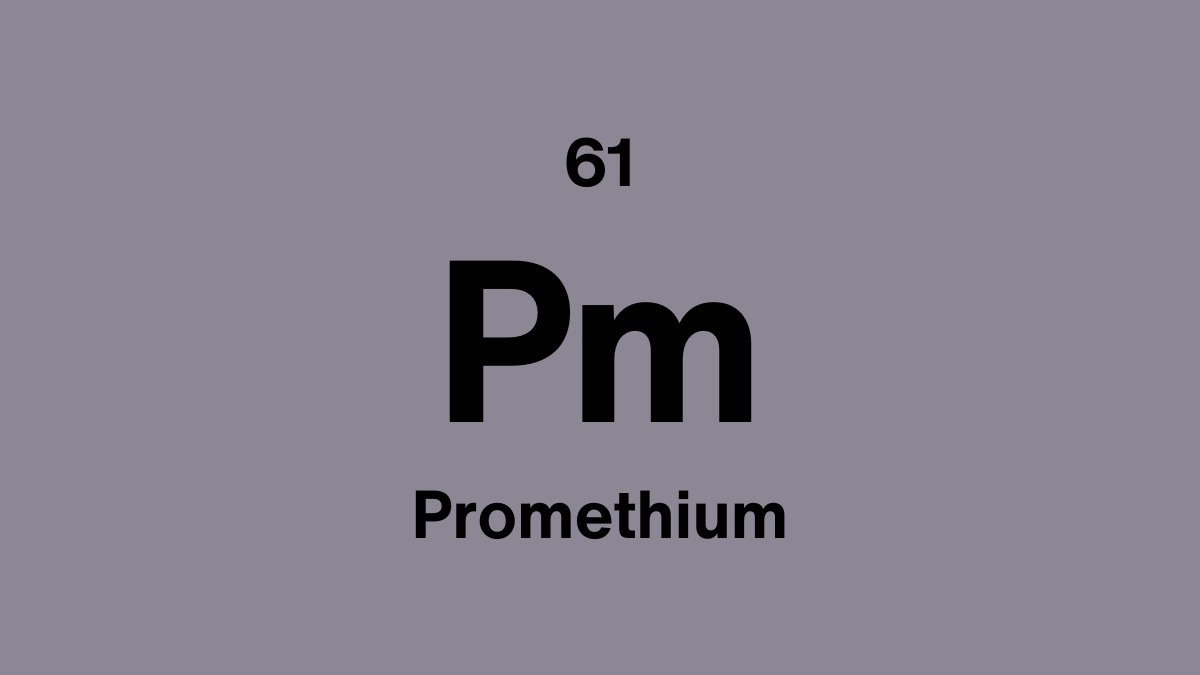
61
Pm
Promethium
145
Atomic Data
| Atomic Number | 61 |
| Symbol | Pm |
| Atomic Weight | 145 u |
| Density (STP) | 7.26 g/cm³ |
| Melting Point | 1041.85 °C (1315 K) |
| Boiling Point | 2999.85 °C (3273 K) |
| Electronegativity | 1.13 (Pauling) |
| Electron Config. | 1s2 2s2 2p6 3s2 3p6 3d10 4s2 4p6 4d10 4f5 5s2 5p6 6s2 |
| Oxidation States | +3 |
| Phase at STP | Solid |
| Category | Lanthanoid |
| Period / Group | 6 / None |
| CAS Number | 7440-12-2 |
Electron Configuration
{{BOHR_SVG}}
[Xe] 4f5 6s2
| Shell | n | Subshell | Electrons | Cumulative |
|---|---|---|---|---|
| K | 1 | 1s | 2 | 2 |
| L | 2 | 2s | 2 | 4 |
| L | 2 | 2p | 6 | 10 |
| M | 3 | 3s | 2 | 12 |
| M | 3 | 3p | 6 | 18 |
| M | 3 | 3d | 10 | 28 |
| N | 4 | 4s | 2 | 30 |
| N | 4 | 4p | 6 | 36 |
| N | 4 | 4d | 10 | 46 |
| N | 4 | 4f | 5 | 51 |
| O | 5 | 5s | 2 | 53 |
| O | 5 | 5p | 6 | 59 |
| P | 6 | 6s | 2 | 61 |
| Total | 61 | 61 | ||
Isotopes of Promethium
Promethium has two naturally occurring stable isotopes. The most abundant is ¹⁴⁵Pm, comprising None% of all naturally occurring Promethium.
| Isotope | Symbol | Protons | Neutrons | Abundance | Stability |
|---|---|---|---|---|---|
| Promethium-145 | ¹⁴⁵Pm | 61 | 84 | trace | Stable |
| Promethium-147 | ¹⁴⁷Pm | 61 | 86 | trace | Stable |
Abundance & Occurrence
Promethium is present in Earth's crust at approximately trace amounts by mass and at approximately trace amounts by mass throughout the universe.
Earth's Crust (ppm by mass)
Promethium
None ppm
Silicon (ref.)
277,000 ppm
Oxygen (ref.)
461,000 ppm
Universe (ppm by mass)
Promethium
None ppm
Helium (ref.)
230,000 ppm
Hydrogen (ref.)
739,000 ppm
Discovery & History
{{HISTORY_TIMELINE}}
Safety & Handling
-
{{SAFETY_BULLETS}}
Promethium in the Real World
Real-World Uses
-
{{USES_LIST_ITEMS}}
Downloadable Resources
Free periodic table reference sheets for classrooms, study sessions, and laboratory use.