Potassium
Atomic Data
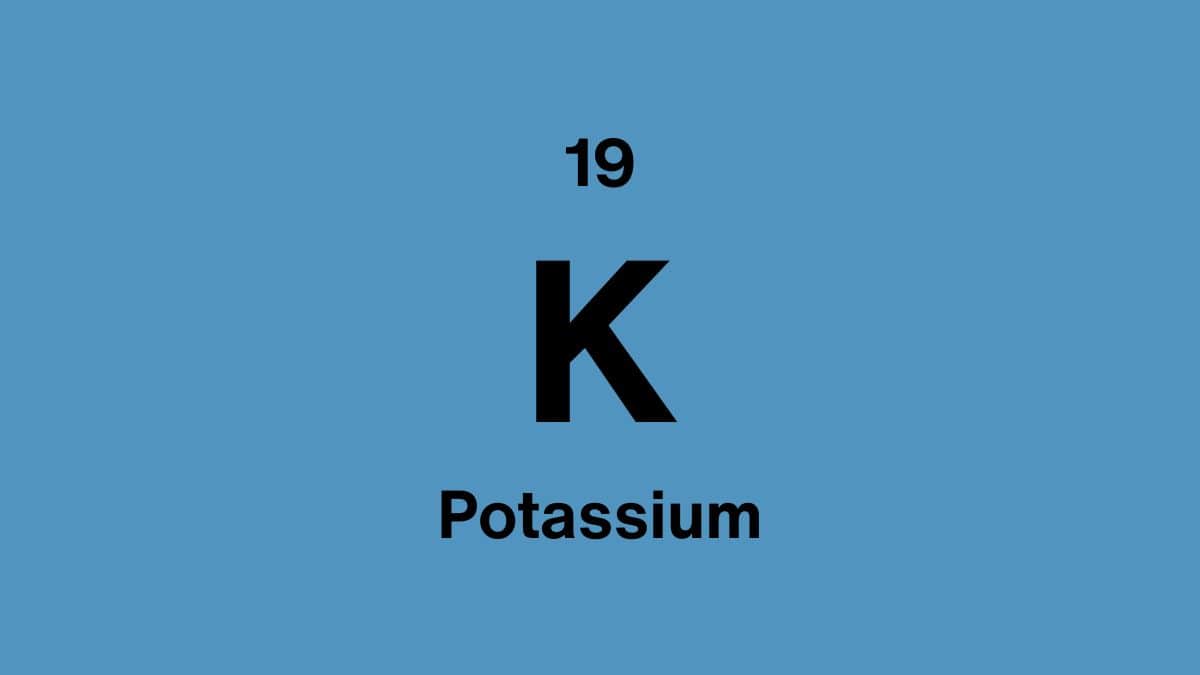
| Atomic Number | 19 |
| Symbol | K |
| Atomic Weight | 39.098 u |
| Density (STP) | 0.862 g/cm³ |
| Melting Point | 63.38 °C (336.53 K) |
| Boiling Point | 758.85 °C (1032 K) |
| Electronegativity | 0.82 (Pauling) |
| Electron Config. | 1s² 2s² 2p&sup6; 3s² 3p&sup6; 4s¹ |
| Oxidation States | +1 |
| Phase at STP | Solid |
| Category | Alkali metal |
| Period / Group | 4 / 1 |
| CAS Number | 7440-09-7 |
Electron Configuration
1s2 2s2 2p6 3s2 3p6 4s1
| Shell | n | Subshell | Electrons | Cumulative |
|---|---|---|---|---|
| K | 1 | 1s | 2 | 2 |
| L | 2 | 2s | 2 | 4 |
| L | 2 | 2p | 6 | 10 |
| M | 3 | 3s | 2 | 12 |
| M | 3 | 3p | 6 | 18 |
| N | 4 | 4s | 1 | 19 |
| Total | 19 | 19 | ||
Isotopes of Potassium
Potassium has three naturally occurring isotopes. Two are stable; potassium-40 is radioactive with a half-life of 1.248 billion years and accounts for most of the natural radioactivity found in the human body.
| Isotope | Symbol | Protons | Neutrons | Abundance | Stability |
|---|---|---|---|---|---|
| Potassium-39 | ₃₉K | 19 | 20 | 93.2581% | Stable |
| Potassium-40 | ₄₀K | 19 | 21 | 0.0117% | Radioactive (t½ = 1.248×10⁹ yr) |
| Potassium-41 | ₄₁K | 19 | 22 | 6.7302% | Stable |
Abundance & Occurrence
Potassium is the seventh most abundant element in Earth's crust at approximately 20,900 ppm (about 2.09% by mass). It never occurs as a free metal in nature due to its high reactivity, but is found widely in silicate minerals such as feldspar and mica, and in evaporite salt deposits of potassium chloride (sylvite) and potassium sulfate.
EARTH'S CRUST COMPOSITION (BY MASS)
HUMAN BODY COMPOSITION (BY MASS)
Discovery & History
Safety & Handling
- Violent water reaction: Metallic potassium reacts immediately with water or atmospheric moisture to produce potassium hydroxide and hydrogen gas. The heat generated ignites the hydrogen, causing fire or explosion — even small pieces are hazardous.
- Severe burns: Skin contact causes deep chemical burns. The potassium hydroxide produced in the reaction is highly caustic and causes tissue damage on contact with skin, eyes, or mucous membranes.
- Storage in mineral oil: Potassium must be stored fully submerged in mineral oil or under an inert gas to prevent reaction with atmospheric oxygen and water. Oxidised surface layers can form shock-sensitive potassium peroxide and superoxide.
- Class D fire hazard: Potassium fires cannot be extinguished with water, CO₂, or standard foam extinguishers. Use dry powder (Class D extinguisher) or dry sand only.
- Compound hazards: Potassium hydroxide (KOH) is a strong corrosive base. Potassium cyanide (KCN) is acutely lethal and requires specialist handling. Potassium permanganate (KMnO₄) is a strong oxidiser that can spontaneously ignite organic materials on contact.
Potassium in the Real World
Real-World Uses
- Fertiliser production (potash) — Potassium chloride (KCl) and potassium sulfate are the primary sources of potassium in agricultural fertilisers. Potassium supports root development, drought tolerance, and disease resistance in crops, making it one of the three essential macronutrients (N, P, K) used worldwide.
- Salt substitute in food — Potassium chloride is widely used as a low-sodium alternative to table salt and as a food preservative. It provides a similar saltiness to sodium chloride without contributing to hypertension, making it common in reduced-sodium products.
- Glass manufacturing — Potassium carbonate (potash) has been used in glassmaking for centuries. Modern specialty glasses — including optical lenses, television screens, and laboratory glassware — use potassium compounds to improve clarity, strength, and refractive properties.
- Industrial potassium hydroxide (KOH) — KOH is a major industrial base used in the manufacture of liquid soaps, biodiesel, electrolytes for alkaline batteries, and as a chemical reagent in numerous industrial processes.
- Medical electrolyte solutions — Potassium is critical for cardiac and skeletal muscle function. Potassium chloride infusions and oral supplements treat hypokalemia (dangerously low potassium), a condition that can cause life-threatening cardiac arrhythmias if left untreated.
Downloadable Resources
Free periodic table reference sheets for classrooms, study sessions, and laboratory use.
Frequently Asked Questions
Why is potassium's symbol K and not P?
The symbol K comes from the Latin word Kalium, which was derived from the Arabic word al-qali meaning alkali. The symbol P was already taken by phosphorus when potassium was formally named. Humphry Davy, who isolated it in 1807, originally called it potassium after potash.
What happens when potassium reacts with water?
Potassium reacts vigorously and exothermically with water to produce potassium hydroxide (KOH) and hydrogen gas. The reaction is fast enough to ignite the hydrogen, producing a characteristic lilac flame. Even small pieces of metallic potassium can cause fires or explosions on contact with water or moisture.
Why is potassium important for the human body?
Potassium is essential for maintaining the electrical potential across cell membranes, which drives nerve impulse transmission and muscle contraction — including the heartbeat. It also regulates fluid balance and blood pressure. Adults require about 2.5–3.5 g of potassium per day, obtained from foods such as bananas, potatoes, and leafy greens.
Is potassium-40 radioactive?
Yes. Potassium-40 (₄₀K) is a naturally occurring radioactive isotope that makes up 0.0117% of all potassium. It has a half-life of 1.248 billion years and decays by beta emission to calcium-40 and by electron capture to argon-40. The decay to argon is used in potassium–argon radiometric dating of rocks and minerals.
Who discovered potassium and how?
Humphry Davy first isolated potassium in 1807 by passing an electric current through molten potash (potassium hydroxide) — a technique known as electrolysis. It was the first metal ever isolated by electrolysis and the first new element isolated using electrical means.