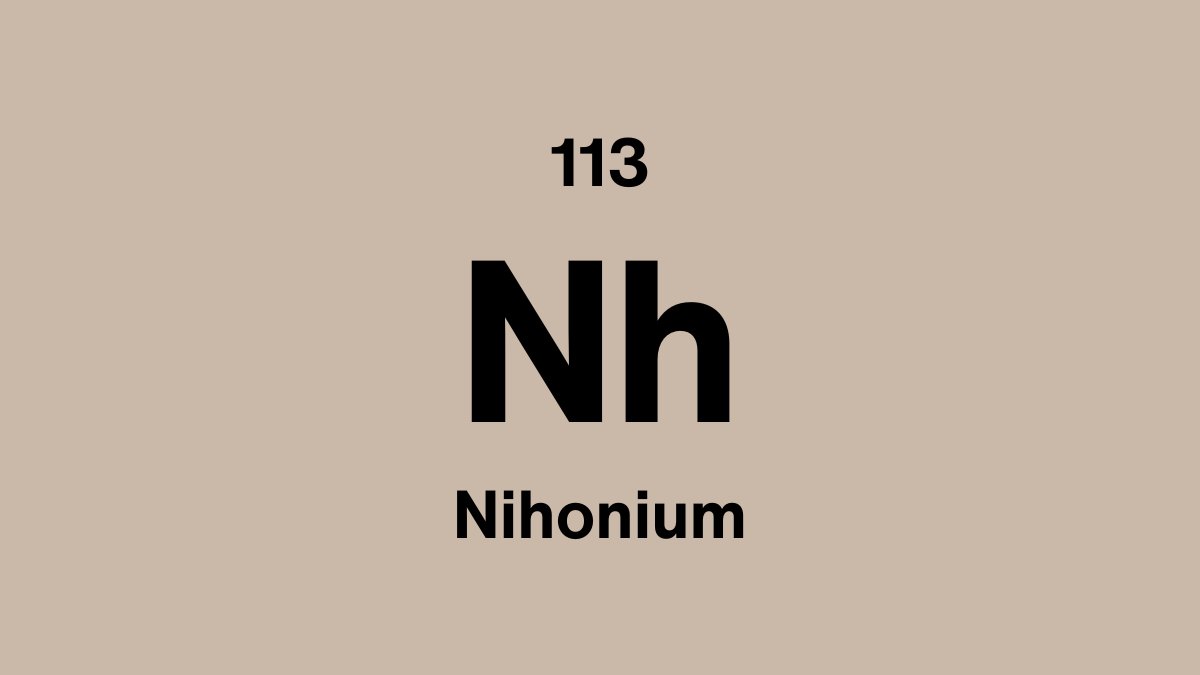
Nihonium
Atomic Data
| Atomic Number | 113 |
| Symbol | Nh |
| Atomic Weight | 286 u |
| Density (STP) | N/A |
| Melting Point | N/A °C (None K) |
| Boiling Point | N/A °C (None K) |
| Electronegativity | : |
| Electron Config. | 1s2 2s2 2p6 3s2 3p6 3d10 4s2 4p6 4d10 4f14 5s2 5p6 5d10 5f14 6s2 6p6 6d10 7s2 7p1 |
| Oxidation States | +1, +3 |
| Phase at STP | Solid |
| Category | Post-Transition Metal |
| Period / Group | 7 / 13 |
| CAS Number | 54084-70-7 |
Electron Configuration
[Rn] 5f14 6d10 7s2 7p1
| Shell | n | Subshell | Electrons | Cumulative |
|---|---|---|---|---|
| K | 1 | 1s | 2 | 2 |
| L | 2 | 2s | 2 | 4 |
| L | 2 | 2p | 6 | 10 |
| M | 3 | 3s | 2 | 12 |
| M | 3 | 3p | 6 | 18 |
| M | 3 | 3d | 10 | 28 |
| N | 4 | 4s | 2 | 30 |
| N | 4 | 4p | 6 | 36 |
| N | 4 | 4d | 10 | 46 |
| N | 4 | 4f | 14 | 60 |
| O | 5 | 5s | 2 | 62 |
| O | 5 | 5p | 6 | 68 |
| O | 5 | 5d | 10 | 78 |
| O | 5 | 5f | 14 | 92 |
| P | 6 | 6s | 2 | 94 |
| P | 6 | 6p | 6 | 100 |
| P | 6 | 6d | 10 | 110 |
| Q | 7 | 7s | 2 | 112 |
| Q | 7 | 7p | 1 | 113 |
| Total | 113 | 113 | ||
Isotopes of Nihonium
Nihonium is monoisotopic: ²⁸⁶Nh is its only naturally occurring stable isotope, accounting for 100% of all natural Nihonium.
| Isotope | Symbol | Protons | Neutrons | Abundance | Stability |
|---|---|---|---|---|---|
| Nihonium-286 | ²⁸⁶Nh | 113 | 173 | trace | Stable |
Abundance & Occurrence
Nihonium is present in Earth's crust at approximately trace amounts by mass and at approximately trace amounts by mass throughout the universe.
Earth's Crust (ppm by mass)
Universe (ppm by mass)
Discovery & History
Read more about the discovery of the periodic table of elements →
Safety & Handling
- Alpha radiation and very short half-life: Nihonium isotopes are alpha emitters; Nh-286 (t½ = 9.5 s) is among the longer-lived, limiting chemical studies to rapid automated techniques.
- No practical hazard: Only a few dozen atoms of nihonium have ever been produced; there is no macroscopic radiological, chemical, or toxicological hazard from the element.
- Accelerator environment: The RIKEN Nishina Center cyclotron, used to produce nihonium, generates significant prompt radiation during bombardment; facility-level radiation protection controls are the primary safety concern.
- Regulatory controls: All nihonium research takes place under national nuclear regulatory authority licence in Japan, with comprehensive radiation protection and material accountancy.
Nihonium in the Real World
Real-World Uses
- First Asian-discovered element: Nihonium (Nh-286) was the first element synthesised and confirmed by a non-Western team (RIKEN, Japan); its discovery and naming in 2015 represent a landmark in the history of element synthesis and the global reach of nuclear science.
- Relativistic chemistry predictions: Nihonium is predicted by relativistic calculations to have a closed 7p¹₅² sub-shell ground state, potentially making it behave more like a noble metal than thallium (its Group 13 homologue), but experimental chemical studies remain beyond current capability.
- No commercial applications: Nihonium is produced a few atoms per experiment (typically 2–6 atoms per run); its most stable isotope (Nh-286) has a half-life of about 9.5 seconds, precluding any practical application.
Downloadable Resources
Free periodic table reference sheets for classrooms, study sessions, and laboratory use.
Frequently Asked Questions
Has nihonium ever been used for anything?
No. Nihonium has no practical applications. Its most stable isotope (Nh-286) has a half-life of about 9.5 seconds. It is produced only a few atoms at a time and used solely for fundamental nuclear research. Nihonium holds the distinction of being the first element discovered by an Asian research team.
How many atoms of nihonium have been made?
Nihonium was extraordinarily difficult to synthesise. The team at RIKEN in Japan spent nine years (2004–2012) bombarding bismuth-209 targets with zinc-70 ions to produce just three confirmed atoms of nihonium-278. Producing those three atoms required over 100 quadrillion ion beam collisions. The element's synthesis was confirmed and the RIKEN team given naming rights in 2016.
Is nihonium radioactive?
Yes, all isotopes of nihonium are radioactive. The most stable, Nh-286, has a half-life of about 9.5 seconds. The isotope first produced, Nh-278, has a half-life of only 0.17 seconds. All nihonium atoms decay almost immediately after production.
How did nihonium get its name?
Nihonium was named after Nihon (日本), the Japanese word for Japan. The element was synthesised by a team at the RIKEN Nishina Center for Accelerator-Based Science in Wako, Japan, led by Kosuke Morita. It was the first element to be discovered and named by a research team in Asia. The name and symbol (Nh) were approved by IUPAC in 2016.