Cadmium
TRANSITION METAL · GROUP 12 · PERIOD 5
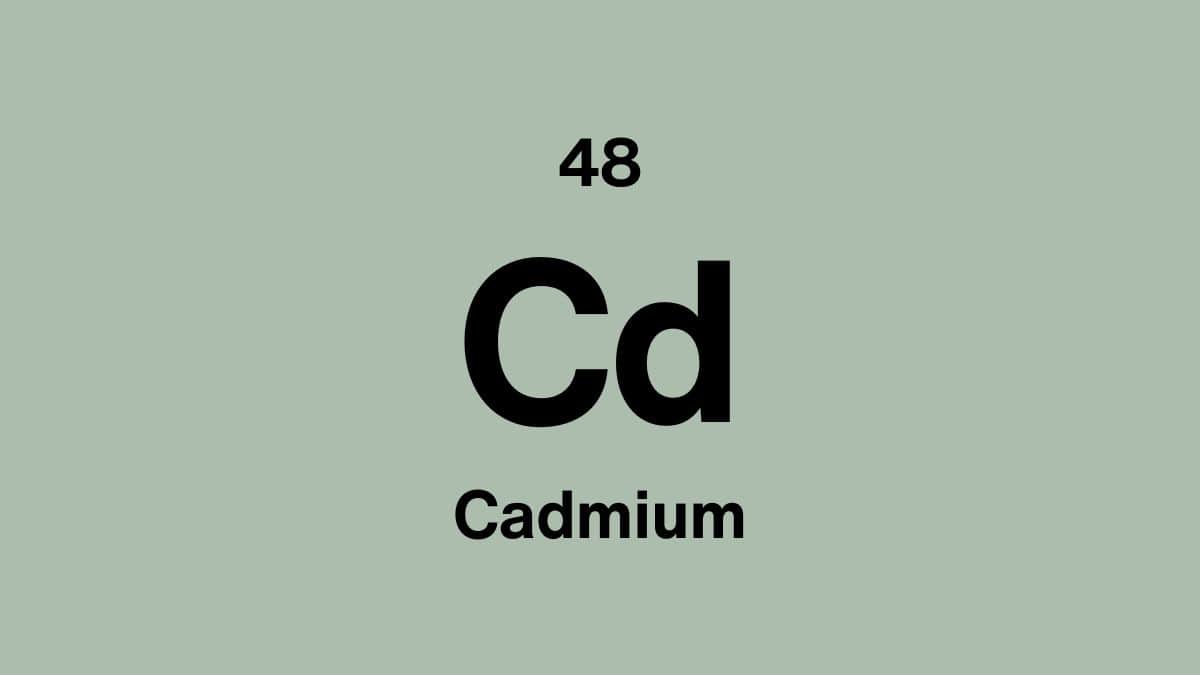
48
Cd
Cadmium
112.41
Atomic Data
| Atomic Number | 48 |
| Symbol | Cd |
| Atomic Weight | 112.41 u |
| Density (STP) | 8.65 g/cm³ |
| Melting Point | 321.07 °C (594.22 K) |
| Boiling Point | 766.85 °C (1040 K) |
| Electronegativity | 1.69 (Pauling) |
| Electron Config. | 1s2 2s2 2p6 3s2 3p6 3d10 4s2 4p6 4d10 5s2 |
| Oxidation States | +2 |
| Phase at STP | Solid |
| Category | Transition Metal |
| Period / Group | 5 / 12 |
| CAS Number | 7440-43-9 |
Electron Configuration
{{BOHR_SVG}}
[Kr] 4d10 5s2
| Shell | n | Subshell | Electrons | Cumulative |
|---|---|---|---|---|
| K | 1 | 1s | 2 | 2 |
| L | 2 | 2s | 2 | 4 |
| L | 2 | 2p | 6 | 10 |
| M | 3 | 3s | 2 | 12 |
| M | 3 | 3p | 6 | 18 |
| M | 3 | 3d | 10 | 28 |
| N | 4 | 4s | 2 | 30 |
| N | 4 | 4p | 6 | 36 |
| N | 4 | 4d | 10 | 46 |
| O | 5 | 5s | 2 | 48 |
| Total | 48 | 48 | ||
Isotopes of Cadmium
Cadmium has eight naturally occurring stable isotopes. The most abundant is ¹¹⁴Cd, comprising 28.73% of all naturally occurring Cadmium.
| Isotope | Symbol | Protons | Neutrons | Abundance | Stability |
|---|---|---|---|---|---|
| Cadmium-106 | ¹⁰⁶Cd | 48 | 58 | 1.25 | Stable |
| Cadmium-108 | ¹⁰⁸Cd | 48 | 60 | 0.89 | Stable |
| Cadmium-110 | ¹¹⁰Cd | 48 | 62 | 12.49 | Stable |
| Cadmium-111 | ¹¹¹Cd | 48 | 63 | 12.8 | Stable |
| Cadmium-112 | ¹¹²Cd | 48 | 64 | 24.13 | Stable |
| Cadmium-113 | ¹¹³Cd | 48 | 65 | 12.22 | Stable |
| Cadmium-114 | ¹¹⁴Cd | 48 | 66 | 28.73 | Stable |
| Cadmium-116 | ¹¹⁶Cd | 48 | 68 | 7.49 | Stable |
Abundance & Occurrence
Cadmium is present in Earth's crust at approximately 0.15 ppm by mass and at approximately 2 ppm by mass throughout the universe.
Earth's Crust (ppm by mass)
Cadmium
0.15 ppm
Silicon (ref.)
277,000 ppm
Oxygen (ref.)
461,000 ppm
Universe (ppm by mass)
Cadmium
2 ppm
Helium (ref.)
230,000 ppm
Hydrogen (ref.)
739,000 ppm
Discovery & History
{{HISTORY_TIMELINE}}
Safety & Handling
-
{{SAFETY_BULLETS}}
Cadmium in the Real World
Real-World Uses
-
{{USES_LIST_ITEMS}}
Downloadable Resources
Free periodic table reference sheets for classrooms, study sessions, and laboratory use.